
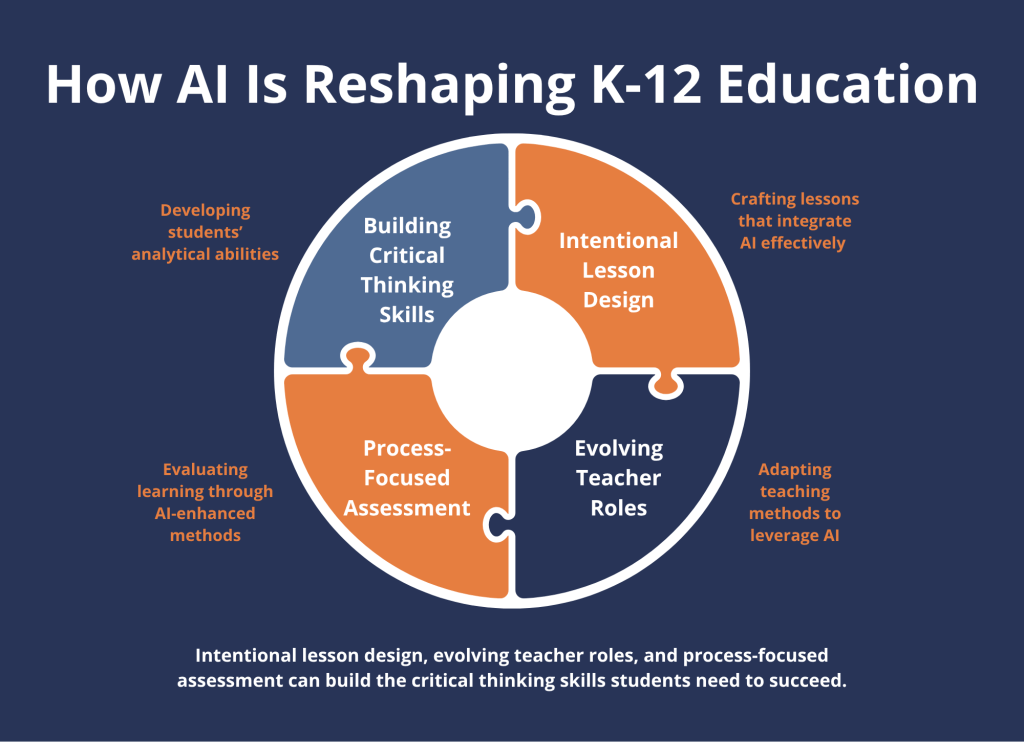
Artificial intelligence is transforming how students learn and how teachers teach. As AI tools become more accessible, K–12 educators face new challenges and opportunities. The core question is no longer how to prevent cheating, but how to design learning experiences that leverage AI while fostering the critical thinking skills students need for the future.
Why Critical Thinking Matters More Than Ever
AI excels at retrieving facts, generating text, and even analyzing data patterns. Traditional assignments that focus on recall or formulaic writing can be completed by a chatbot in seconds. That reality makes it clear: schools must shift from product-based tasks to process-oriented activities. By centering learning on analysis, evaluation, and creation, teachers ensure students engage in the kind of higher-order thinking that machines cannot replace.
Research confirms that assignments requiring students to explain their reasoning, weigh evidence, and connect ideas promote deeper understanding and long-term retention. When students reflect on how they solved a problem or defend an original perspective, they develop metacognitive skills that serve as a foundation for lifelong learning.
Rethinking Lesson and Assignment Design
Effective AI-resistant lessons share common features:
- Open-ended prompts: Questions like “What alternative endings could this story have?” or “How would you solve this community issue?” demand unique responses.
- Process documentation: Requiring drafts, brainstorm notes, or self-reflections makes the thinking visible and reduces the appeal of copy-and-paste answers.
- Authentic tasks: Real-world challenges, such as designing a local sustainability plan or creating a historical podcast, connect learning to students’ lives and interests.
For example, rather than a standard five-paragraph essay on climate change, a science teacher might ask students to propose and model one solution for their school. Students would gather data, test prototypes, and present findings with evidence, shifting the focus from a static product to a dynamic process.
The Evolving Role of the Teacher
In AI-enhanced classrooms, teachers become facilitators of inquiry and reflection. Their key responsibilities include:
- Guiding question-formulation
Helping students learn how to ask precise, meaningful questions sets the stage for purposeful exploration. - Modeling evaluation
Teachers demonstrate how to verify AI outputs, fact-check sources, and critique arguments. - Designing learning experiences
By crafting projects that require creativity and critical judgment, educators turn AI into a thought partner rather than a shortcut. - Providing personalized feedback
With AI handling routine tasks like generating practice problems or flagging grammar errors, teachers can focus on coaching student reasoning and offering targeted strategies for improvement.
This “human-AI-human” cycle starts with student inquiry, moves through AI-assisted information gathering, and ends with student reflection under teacher guidance. That structure keeps human judgment at the center of learning.
Assessment Tools for Process-Focused Learning
Traditional tests and take-home essays are vulnerable to AI assistance. Instead, consider these strategies:
- Oral defenses and presentations
Live or video-recorded explanations force students to articulate their understanding in real time, making it difficult to hide behind prewritten AI text. - Portfolio assessments
Students curate a body of work—drafts, revisions, reflections—that document their growth over time. Rubrics reward analysis, creativity, and evidence-based reasoning. - Performance-based tasks
Simulations, experiments, and design challenges reveal how students apply concepts to novel problems. Grading focuses on process and decision-making rather than a single correct answer. - Metacognitive prompts
Brief “exit tickets” or journal entries asking students to reflect on their strategy, assumptions, or next steps encourage self-awareness and continuous improvement.
By emphasizing the learning journey, these assessment methods align grading with the skills we truly value: critical thinking, problem-solving, and adaptability.
Frameworks to Support Critical Thinking
Several established models offer guidance for designing rigorous AI-resistant instruction:
- Bloom’s Taxonomy (Revised)
Structure activities around the upper tiers—analyze, evaluate, and create—to ensure students engage in complex cognitive tasks. - Webb’s Depth of Knowledge
Aim for Level 3 (strategic thinking) and Level 4 (extended thinking), where students must justify decisions, synthesize information, and connect ideas across contexts. - Socratic Questioning
Facilitate student-led discussions that probe underlying assumptions and explore multiple perspectives.
Using these frameworks helps teachers plan lessons that inherently resist simple AI solutions and foster genuine critical engagement.
Curriculum Resources and Professional Learning
Educators do not need to navigate this shift alone. A wealth of resources and PD opportunities can support the transition:
- UNESCO AI Competency Frameworks outline student and teacher competencies in evaluating AI outputs, understanding ethical implications, and integrating AI responsibly.
- AI4K12 guidelines present core AI concepts and lesson plans that introduce AI through inquiry-based activities, reinforcing critical thinking about technology itself
- AI Guidance for Arizona Schools has resources designed to give schools and school systems common language and direction.
- Skill Surge Consulting is available for a variety of customizable professional development sessions such as AI Literacy, AI Strategic Planning, AI Implementation Guidance, and Critical Thinking in the Age of AI.
Local and online teacher networks—such as Twitter chats, EdTech communities, and professional learning cohorts—share practical strategies, lesson ideas, and cautionary tales, creating a support system for educators embracing AI.
Moving Forward: Cultivating Lifelong Learners
The promise of AI in education lies not in replacing teachers or eliminating student effort, but in enriching the learning process. When assignments demand genuine inquiry, when teachers guide reflection, and when assessments capture reasoning, students develop the critical thinking skills they need to navigate an ever-changing world.
By reimagining lesson design, redefining assessment, and leveraging proven frameworks, K–12 educators can transform AI from a potential threat into a catalyst for deeper learning. In doing so, they prepare students not simply to answer questions, but to ask them, to analyze and evaluate information, and to create innovative solutions. In the age of AI, those human strengths are more essential than ever.
 Skill Surge Consulting